
Contient des Sulfites mais aussi du vin !
On m’a redemandé, récemment, pourquoi sur les étiquettes des bouteilles de vin, il y a cette fameuse mention “Contient des Sulfites“ ou « Contient du SO2« .

Comme nous ne sommes pas tous diplômé de chimie, il est vrai que le manque d’information et d’explication sur cette mention, alimente certains fantasmes qu’il convient de réfréner sérieusement.
Cette mention est un bon exemple de mesures prises par les autorités compétentes pour prévenir le grand public d’un danger potentiel, alors que ce même grand public, en ignore entièrement la signification. D’où des confusions et quelques raccourcis rapides chez certains. Les sulfites, ou SO2, ou encore, de son petit nom scientifique, l’anhydride sulfureux, sont des substances couramment utilisés dans la vigne et dans la cave. Et ce, depuis des siècles, sous d’autres formes bien sûr qu’aujourd’hui. C’est le produit miracle du vigneron car il protège la vendange de l’oxydation, bloque la fermentation des raisins, et, stabilise le vin.
Il est utilisé à différentes étapes de l’élaboration d’un vin.
Depuis le 25 Novembre 2005, une directive européenne rend obligatoire la mention “contient des sulfites” ou “E220″ sur l’étiquette du vin, du même côté que les autres mentions obligatoires que sont la dénomination du vin, le titre alcoométrique, le volume, l’embouteilleur, le lieu d’embouteillage, le numéro de lot et le message de prévention pour les femmes enceintes. Ceci si le taux de sulfites est supérieur à 10 mg par litre.
C’est simplement parce que le sulfite est, pour certain, une substance allergène, dont ils doivent se prémunir, même à très petite dose. Cela ne veut pas dire que le vin n’est pas bon, ou qu’il est bourré de substances non naturelles ou encore qu’il va donner mal à la tête.
Par contre, c’est le véritable excès d’emploi des sulfites qui entraine un gout de piquette et un gros mal de tête le lendemain. Mais ce sont pour des doses bien supérieures à 10 mg/l. Au pire, cela peut aller jusqu’à 160 mg/l pour les vins rouges et 210 mg/l pour les vins blancs. Y’a de la marge, voyez-vous !
En clair, cette mention, pour la plupart des consommateurs, n’a aucune utilité, puisqu’elle n’indique pas la dose contenue de sulfite. Elle ne sert que pour ceux qui sont allergiques et qui, de toutes façons, ne boivent pas de vin car même un vin sans ajout de SO2 en contient naturellement quelques mg.
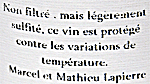
Faites-vous ce plaisir, chercher donc des vignerons qui utilisent avec parcimonie le SO2. Il en existe de plus en plus, notamment les adeptes de la biodynamie et des vins naturels. C’est au moins le signe qu’ils respectent au maximum le raisin et la vendange et qu’ils maitrisent leur cave.
Et surtout, n’oubliez pas, le sulfite, ce n’est pas que pour le vin ! D’ailleurs, vous pouvez le trouver dans des aliments comme les céréales, la semoule de maïs, le müesli, la
charcuterie, les hot dogs, les saucisses, la choucroute, les nouilles, le riz, les épices, le thé, les confitures, la marmelade, les boissons gazeuses, les mélanges montagnards…etc…

Est-ce q’un vin trop sulfité donne une sensation de bouce pâteuse?
Bonjour,
Il existe un livre de Arnaud Immele qui s’intitule
LES GRANDS VINS SANS SULFITE 1er traité de vinification sans sulfite
http://store.oeno.tm.fr/libfr/pratiques/sulfites.html
L’auteur est porté par la conviction que produire du vin sans sulfite demande de redoubler de rigueur. La baisse des sulfites doit être planifiée et réfléchie dans une stratégie de vinification où chaque étape est préparée au non-sulfitage. Arnaud Immélé partage ainsi sa longue expérience, ordonne ses observations et fait référence à de nombreux travaux de recherche et bancs d’essais.
…vers une autre approche possible de l’œnologie
Au-delà de l’élimination des sulfites, ce qui rend cet ouvrage particulièrement intéressant et même passionnant, c’est que l’on y découvre une autre approche de l’œnologie et des propositions pour l’élaboration de meilleurs vins, pour une meilleure expression du terroir et de la typicité.
Je vous le conseil aux éditions oenoplurimedia infos@mail.oeno.tm.fr pour le commander http://store.oeno.tm.fr/libfr/pratiques/sulfites.html