Le vin ‘bio’ : Travailler plus pour produire mieux
Définition
Disposer du label AB sur son étiquette de vin c’est indiquer que le vin est issu de raisins de l’agriculture biologique et qu’il a été certifié par un organisme agréé. En effet, les règles de production biologiques sont consignées dans des cahiers des charges établis par les professionnels et homologués par l’État français et/ou par l’Union Européenne. Le respect de ces règles est vérifié par des organismes certificateurs indépendants qui contrôlent chaque unité de production et de transformation de produits biologiques. Ce contrôle, payé par l’opérateur, est effectué au minimum une fois par an et autant que nécessaire en rapport avec la complexité du processus de fabrication, tant pour la production que pour la transformation ; il aboutit à la certification des produits. Il est pour le consommateur la garantie que les produits qu’il achète auront été élaborés en respectant des cahiers des charges rigoureux. De ce fait, vous retrouvez sur les produits bio ces deux logos distinctifs :
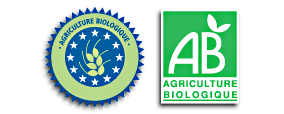
L’Agriculture Biologique garantit une qualité attachée à un mode de production respectueux de l’environnement.Elle se distingue par ce mode de production, fondé notamment sur la non-utilisation de produits chimiques de synthèse, le recyclage des matières organiques, la rotation des cultures et la lutte biologique. Elle assure que le vigneron n’a pas utilisé de produits chimiques de synthèse pour traiter sa vigne. Par contre, il peut faire ce qu’il veut en cave.
L’étape de transformation du raisin en vin n’est pas concerné par la certification officielle.
Fédération Nationale Interprofessionnelle des Vins de l’Agriculture Biologique
Des vignerons veulent aller plus loin et souhaitent certifier l’ensemble de leurs procédures pour un véritable vin bio. C’est le cas notamment de la Fédération Nationale Interprofessionnelle des Vins de l’Agriculture Biologique, la FNIVAB, qui publie et travaille sur une charte. Les vignerons qui répondent à ce cahier des charges peuvent apposer le logo de la FNVAB sur leur production.


Pour ceux qui souhaitent lire la charte (c’est un peu technique).
ORWINE : Un vin bientôt 100% Bio
ORWINE, c’est le nom du programme de recherche européen qui a pour mission de permettre à la commission européenne, en lui pré-mâchant tout un package de données scientifiques, de poser un cadre législatif concernant les règles de vinification Biologique commune aux pays de l’Union Européenne. Orwine qui fonctionne avec un budget total de 1400 K€ sur 3 ans, est conduit par 4 pays principaux :
L’Allemagne avec Ecovin (association de producteurs biologiques), Université de Gesenheim ;
La Suisse avec le FIBL (institut de recherche en Agriculture Biologique);
L’Italie avec l’AIAB (association de producteurs biologiques) principalement, et Vinidea (PME spécialisée dans la formation et la communication dans le domaine viticole) ;
La France avec l’ITAB, ITV, INRA de Montpellier.
Lors d’une récente conférence au salon Millesime Bio, j’ai rencontré Monique Jonis, en charge du programme à l’ITAB (Institut Technique de l’Agriculture Biologique). Voilà, ce qu’elle en dit :
“Nous avons effectué différentes études, à l’échelle de l’Europe, afin de déterminer des points importants en matière de vinification biologique.
Tout d’abord, nous avons relevé l’ensemble des chartes de vinification existantes à travers l’Europe afin de les comparer et de mettre en évidence les points communs et les points de divergences. Bien que relativement très proches, elles marquent certaines différences importantes notamment à propos de la teneur en SO2. Plus on va vers le Sud de l’Europe et moins le Soufre est nécessaire.
Ensuite, nous avons effectué des enquêtes sur des consommateurs de vin pas forcément Bio et sur des consommateurs de produits Bio de manière générale. Cela a mise en évidence que si les consommateurs perçoivent que ce sont des vins moins chargés en produits et qu’ils respectent l’environnement, ils ont cependant encore un image pas très qualitative des vins bio. Peut-être en partie à cause des débuts un peu aléatoire en matière de qualité des vins bio.
Il y a eu aussi une enquête auprès des acheteurs européens qui a révélé plusieurs points importants dont un manque et un besoin de connaissance de la filière concernant les vins bio et leurs caractéristiques, un besoin en matière de communication sur le produit, un rapport qualité-prix peu avantageux et une forte demande pour une simplification et une harmonisation européenne.
Une étude a également été menée sur les pratiques des producteurs Bio, via un questionnaire sur internet et des entretiens. Le questionnaire a été entièrement renseigné par 467 producteurs, soit environ 18% de la population ciblée, dont 192 de la France. Selon les résultats de l’enquête, le prototype du vigneron biologique européen, a un domaine petit à moyen, cultive ses propres vignes et a des pratiques très proches des pratiques conventionnelles, mais, avec l’exclusion totale de la chimie de synthèse et avec un souci d’expression du terroir et de typicité des cépages.
La gestion du sol constitue le principal changement de pratique au moment de la conversion. L’enquête révèle l’importance de l’attention et de l’expérience portées à la gestion du sol. 80% des producteurs utilisent toute une gamme d’outils pour optimiser le travail du sol de leur vignes. Dans un même temps, ils s’efforcent de mettre en place un couvert végétal toute l’année sur toute la surface du vignoble.
Le cuivre et le souffre sont utilisés par plus de 90% des producteurs mais ils sont diversement touchés par les attaques de maladies sachant que les pays les plus concernés sont surtout l’Allemagne, l’Autriche et la Suisse. Dans ces pays, à cause des différentes conditions climatiques ainsi que des types et fréquences de maladie, les apports de SO2 sont à considérer différemment, des pays à climat plus doux.
Si une large majorité de producteurs affirme produire des raisins en quantité moindre que leurs collègues conventionnels, néanmoins, presque tous déclarent que cette moindre production est le résultat d’un choix qualitatif plutôt que la conséquence de problèmes techniques.
La majorité des producteurs biologiques n’applique pas des prix plus élevés qu’en conventionnel, pour vins de même origine et sur un même segment de marché.
Le pourcentage de vignerons biologistes utilisant (ou approuvant) des additifs chimiques, est très bas et, ceci représente la principale différence avec le vinification conventionnelle.
Ce sont seulement les consommateurs du Nord de l’Europe qui reconnaissent une valeur supérieure au vin produit par des pratiques naturelles, tandis qu’en Europe du Sud l’appellation « bio » ne représente aucun avantage commercial. C’est pour cette raison que bon nombre de viticulteurs en Italie, en France et en Espagne recherchent activement les marchés d’exportation.
ORWINE doit fournir donc ses propositions pour Avril 2009 avec notamment l’établissement de listes, d’une part de produits autorisés, et d’autres parts de techniques de vinification interdite. Il sera certainement difficile de statuer sur le taux de soufre étant donné les différences observées dans les vins et chez les producteurs.

Source ITAB
-
Ping : L’Europe ne s’accorde pas pour le vin bio | ShowViniste