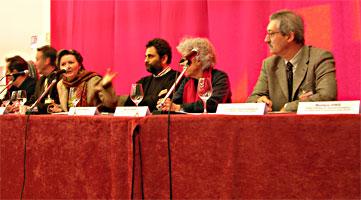
Quel avenir pour la viticulture biologique en France et en Europe ?
C’était l’objet d’une des rencontres professionnelles du 27 janvier 2009 au salon Millésime Bio organisé à Montpellier au Parc des Expositions. En effet, quel avenir pour la viticulture bio ?

Tout d’abord, en ces temps de morosité cultivés, un large sourire illumine l’ensemble des intervenants. Nous sommes clairement sur un secteur porteur qui sort son épingle du jeu et jouit d’une belle croissance. La viticulture biologique suscite de plus en plus d’intérêt de la part des consommateurs et des acheteurs en France et dans le monde. En France, fin 2007, 1 907 viticulteurs cultivaient 22 507 ha de vignes respectant le cahier des charges de l’agriculture biologique avec des contrôles spécifiques, soit une augmentation de 20% du nombre d’exploitations.
Cette tendance qui se confirme, année après année, de progression du vin bio, se retrouve soumis depuis le 1 janvier 2009 à une nouvelle réglementation européenne de l’agriculture biologique, (évoquée et détaillée sur ce blog), avec la mise en place de la directive 834.2007. « Avec cette nouvelle forme », nous assure Madame Marianne Monod, du Bureau des Signes de Qualité au sein du Ministère de l’Agriculture et de la Pêche, « il y a une meilleur structuration des composants de la loi, qui devient ainsi plus claire et mieux exploitées. Le fond lui ne change pas. On retrouve ainsi la liste des produits autorisés, le logo communautaire qui sera en fait changé et obligatoire à partir de 2010 et l’introduction de nouveaux champs comme les semences, l’aquaculture, les levures et les méthodes d’applications, dont celle qui nous intéresse : la vinification. L’Europe a chargé un programme de recherche ORWINE d’étudier et de proposer la mise en oeuvre d’une vinification biologique. Les résultats sont attendus pour 2009″.
En résumé (car j’y reviendrai avec plus de détails plus tard), ORWINE va proposer les modalités des méthodes d’applications en faisant diverses études approfondies sur les pays de l’UE. Il s’agira de faire des propositions parlementaires pour Avril 2009 en trouvant un compromis par exemple sur l’emploi du SO2, l’établissement d’une liste d’additifs autorisés, une liste des techniques interdites et de statuer sur l’ajout de sucre. Vaste débat qu’il faudra bien trancher pour avancer. L’idée sera bien entendu de conserver la qualité Bio du raisin jusque dans le vin, qui doit transmettre sa « vérité » nous dit le représentant de l’INAO. Il y a aussi d’autres réflexions sur les levures ajoutées où il faudra « trouver sagesse et équilibre avec de telles différences entre les vignobles ». L’essentiel sera « de garder toute la richesse viticole pour les vins biologiques« .
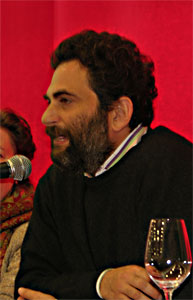
Andréa Ferrante de l’AIAB en Italie nous parle d’une histoire commune entre son pays et la France, avec son bel accent chantant (la photo ci-dessus). Ils ont observé, eux aussi, un marché en croissance alors qu’ils sont dans un environnement plutôt à la baisse sur le marché de l’alimentation. L’agriculture Bio, c’est quasiment une réponse à la crise de par les valeurs qu’elle véhicule. A savoir que ce sont les consommateurs qui sont les plus exigeants. Bien plus que les producteurs. Il y a, sur ce marché, une forte exigence de qualité. D’où l’impériosité d’une réglementation forte et européenne jusque sur la vinification. Il faudra se tenir sur ses gardes affirme Monsieur Ferrante car « il y a une partie de la filière Vin qui ne veut pas d’une réglementation du Vin Bio », puisque, sous-entendu, ils utilisent des intrants chimiques. « Le marché pour le vin bio est ouvert donc on ne doit pas avoir peur de travailler ensemble en Europe » conclut-il.
Cette conférence se termine par un petit mot du président de l’Agence Bio (très efficace), Monsieur Didier Perréol, en réaffirmant que le grenelle de l’environnement est un tournant décisif pour l’agriculture et la viticulture Bio. Le plan Agriculture Biologique du ministre, Monsieur Barnier, se révèle très important et moteur sur la filière qui devrait entrainer le triplement des surfaces en AB soit environ 19 500 ha en Languedoc Roussillon et 67 500 ha en France. Ce plan s’appuie sur plusieurs actions, comme le déplafonnement des aides, la réorientation des moyens de la recherche et du développement et la consolidation des filières grâce à la création d’un fonds doté de 15 millions d’euros sur 5 ans.